WiFi: A Flaw in Your Cybersecurity? Close Your Doors with WPA3!

The arrival of WPA3 is a revolution in securing digital exchanges, offering an unprecedented bulwark against the cyber threats facing businesses and individuals alike. How does WPA3 redefine WiFi security standards, illustrating its crucial importance in today's technological landscape?
That is what we are about to discover.
The Invisible Threat: Understanding Passive Eavesdropping
Passive eavesdropping is one of the most insidious threats in the world of cybersecurity, exploiting the very nature of WiFi networks. This vulnerability is made worse by the ability of WiFi signals to pass easily through walls and other physical barriers, making any wireless communication potentially accessible to a well-equipped attacker.
Vulnerabilities of Unsecured Networks and WPA/WPA2-Personal
On unsecured networks, the absence of encryption gives cybercriminals an open playground, allowing them to easily capture data transmitted over the air. Even networks protected by WPA/WPA2-Personal, although offering a higher level of security than open networks, are not foolproof. The shared encryption key used in these protocols means that any user with access to the WiFi password can potentially decrypt the traffic of other users connected to the same network. This flaw makes it possible to spy on communications and steal sensitive data, such as login credentials, credit card details and private conversations.
The ability of WiFi signals to cross physical barriers has long been a flaw exploitable by cybercriminals. Unsecured networks, and even those protected by WPA/WPA2-Personal, were vulnerable to passive eavesdropping, allowing attackers to capture sensitive data. WPA3 puts an end to this vulnerability thanks to individualised encryption, ensuring that data remains secure and private, even in a shared environment.
WPA3 represents a major advance in protection against passive eavesdropping. By introducing individualised encryption for each communication session, WPA3 ensures that data remains secure and private, even in a shared network environment. This key feature of WPA3, known as "forward secrecy", prevents an attacker who has captured encrypted data from decrypting it later, even if they manage to obtain the network password after the data was captured.
This innovation is made possible by the implementation of the "Simultaneous Authentication of Equals" (SAE) protocol, which replaces the pre-shared key (PSK) authentication method used in WPA2. SAE strengthens the initial negotiation of the encryption key, making each connection unique and secure against interception attempts.
Impact and Implications for Users
For businesses, adopting WPA3 means an additional layer of security to protect sensitive data and internal communications from prying ears. For individuals, it translates into stronger privacy protection and a significant reduction in the risk of identity theft and online fraud.
Stronger Passwords with WPA3
The SAE protocol introduced by WPA3 radically transforms password security. By making brute-force and dictionary attacks obsolete, SAE ensures that even the simplest passwords benefit from robust protection. This advance is a direct response to the limitations exposed by vulnerabilities such as KRACK, which revealed the weaknesses of WPA2.
Improved Authentication and Accessible Security
WPA3 does not merely strengthen security; it also makes it more accessible. By simplifying authentication processes while making them more robust, WPA3 democratises access to high-level WiFi security for all users. This development is crucial for protecting data in a world where cyberattacks are becoming ever more common.
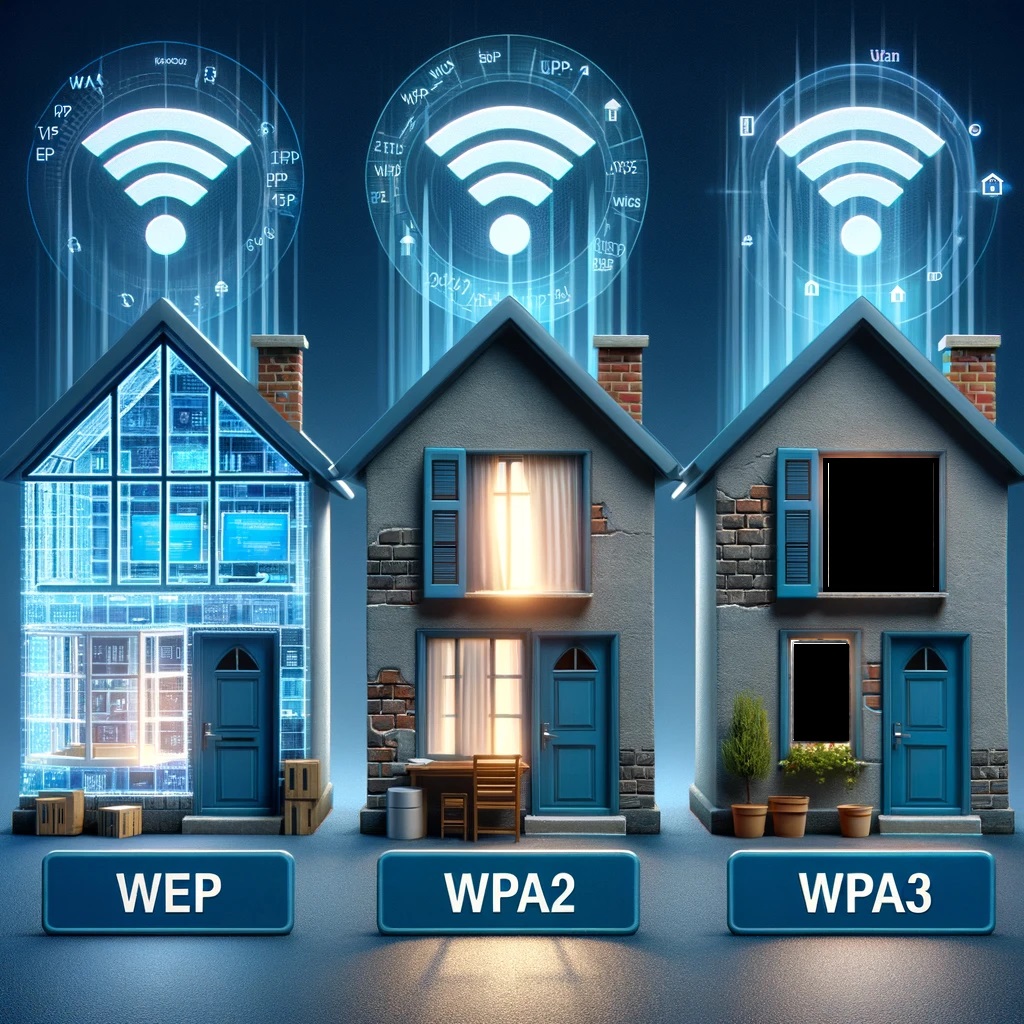
Imagine a diagram in which three houses represent, respectively, a network secured with WEP, another with WPA2 and a network secured with WPA3.
In the first house, the windows are transparent, allowing anyone to look inside and see everything that is going on.
In the second, the windows are more opaque but you can still tell what is going on, while in the last one the windows are completely opaque.
This illustrates the vulnerability of WEP/WPA2 and WPA3 networks to passive eavesdropping. In the third house, secured with WPA3, the windows are fitted with special tinted glass that prevents anyone from seeing in from outside, while allowing the occupants to see clearly from the inside out. Each room in the house has its own type of tinted glass, symbolising the individualised encryption offered by WPA3, ensuring that even if someone could look through a window, they would not be able to see what is happening in the other rooms.
Migrating to WPA3: Equipment and Recommendations
Moving to WPA3 involves upgrading your network equipment to ensure compatibility with this new protocol. Here are a few tips for businesses and individuals wishing to adopt WPA3:
- Check the Compatibility of Your Existing Devices: Some recent devices may already be compatible with WPA3. Check your equipment's documentation or contact the manufacturer to confirm compatibility.
- Update Your Access Points and Routers: To get the full benefit of WPA3, it is often necessary to replace older access points and routers. Look for devices certified WPA3 by the Wi-Fi Alliance, guaranteeing their compliance with the strictest security standards.
- Choosing Suppliers: Opt for brands known for their commitment to security. Companies such as Netgear, Asus, TP-Link and Cisco offer a range of WPA3-compatible products, available in consumer electronics shops or from online retailers such as Amazon and Best Buy, as well as from specialist IT hardware sites.
- Consulting Security Experts: For businesses, support from cybersecurity consultants can make the transition to WPA3 easier, ensuring that the network configuration maximises the protection offered by the new protocol.
Towards a Secure Future with WPA3
Adopting WPA3 is a necessary step towards a more secure digital future. By offering advanced protection against passive eavesdropping, strengthening password security and simplifying authentication, WPA3 redefines Wi-Fi security standards for businesses and individuals alike.
Moving to WPA3 may require an initial investment in upgrading equipment, but the benefits in terms of security and data protection more than justify the effort. By following the recommendations provided and choosing WPA3-compatible equipment, users can browse, work and communicate with confidence, knowing that their data is protected by the latest advances in wireless security.
Powered by E-MED-CYBER